 Logal’s managers knew, even before their IPO, that Wall Street was not waiting for them. Educational software, the field in which Logal operates, is not considered particularly sexy, and as opposed to other software companies, educational software firms do not receive unlimited investor credit. But it seems the cold shoulder surprised even the company’s managers. You can see that CEO Yoel Givol, who helped found Logal over a decade ago, is not happy with the way his share is being treated. "The price is important both to investors and to us, but we don’t manage the company according to tomorrow’s share price," he explains.
It may very well be that Givol and Logal did not have to think about the share at this stage in the company’s development. Givol himself says he "is not sure if he would want to be a public company today, perhaps I would’ve preferred to be a venture capital investment for another year." But the reality is, software companies need to raise capital. "Raising capital on NASDAQ was convenient," he says, "and the question is if we will use the money correctly, in order to advance."
Logal was established in 1985, as a cooperative effort between kibbutzimin the Galilee region, in order to develop educational software. Since its founding, the company has undergone three major changes in management, each bringing with it a major change in business direction.
 The latest incarnation was in 1993, when the company was invested in by a very large and impressive venture capital group. This group included Logal’s initial investors: venture capital fund Gemini, together with the Discount Group, PEC, and the Boston-based private equity investment organization, Advent International. Among Advent investors, the biggest was Apple Computers, which invested in Logal via an Advent-managed fund. Cooperation with Apple was more important to Logal than the investment itself. Other Logal investors were Tolkowski’s AAV, Unicycle Trading, Elron and Ampal. This stage of Logal’s life was characterized by cutting costs, and balancing the books.
Logal chose to take another step, and in March of this year raised $15.2 million on Wall Street. A revolution in Logal’s post-IPO business has yet to take place, but the money raised will be used by the company to move into the fourth stage of its life, that of the Internet.
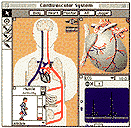
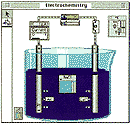
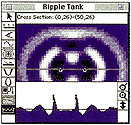
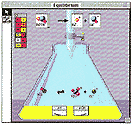
"We issued shares based on our past results. We did not sell dreams," explains Givol. Past accomplishments are Logal’s science education software/hardware packages, and in this field, it is one of the US market leaders. The main dream for the future is the Internet, though Givol says its far beyond the dream stage. "There is no question that in the year 2000, the educational software market will be the Internet market. You can't think of it any other way, because from the minute on-line education penetrates the schools, it can’t go back." For this reason, Logal is preparing to position itself as a leader in the field of remote education.
 Internet potential is made up of three new markets, all of which Logal estimates it can penetrate, due to its knowledge about the way people learn. The first market is that of students who study at home to improve their grades at school. Such pupils put out vast sums of money on private tutors, and have great potential for making the transition to studying by Internet. The second market are students at academic institutions. Givol says that 40% of students at institutions of higher learning are over the age of 30, and study part-time. Working adults, who are also completing graduate degrees or professional certification, would find a positive solution in studying via the Internet, without having to commute. The third market is that of students specializing in more than one subject.
These factors create demand for remote education, not only on the part of students but from universities as well. The number of applicants being accepted to institutions of higher learning has risen rapidly, and there are insufficient funds to build a physical infrastructure to hold them. Logal plans to solve all these problems by creating a virtual campus, to be offered directly not only to students but to academic institutions as well, so that they will be able to offer services to students, without requiring their physical presence.
Students entering Logal’s virtual campus via the Internet would choose the subject they wish to study that day. Givol sees Logal’s future as a content provider; their software will be on the net and whoever wishes to use those services will click on them, pay and learn. He likens his company to the Bloomberg economic information network, but in the educational field. The company is in contact with one of the leading Internet providers, concerning storage of Logal’s system.
 Future improvements which Givol hopes to achieve include the possibility of conversing, either by phone or video conference, with instructors or teachers who could answer questions. These services would also be provided via Internet, and Logal is in contact with leading companies in these areas as well. Givol explains that Logal is going in all directions, but is tailoring itself to the leading companies in each Internet field. Logal’s system is compatible with Netscape 3.0, Microsoft Internet Explorer and JAVA, which Givol feels will become the Internet language.
But although hopes for the Internet are high, there are as yet no Internet revenues, and this situation is expected to continue for the next year and a half. Givol explains that analysis of his company does not take into account any Internet-associated revenues until the end of 1997, and any sale will be merely an unplanned bonus.
In the meantime, Logal is focusing on those activities upon which the IPO was based: education software sales to high schools and vocational schools. Some 3,500 schools have purchased Logal products, and analysts have been impressed by the company’s market penetration within a short three year period. Givol maintains this is just the tip of the iceberg. Many of these institutions bought only 2 or 3 out of Logal’s 50-strong product range.
The remote education via the Internet market is attracting a lot of companies, who mention it as a possible future service. On the other hand, the educational software in general, is problematic, as evidenced by the two Israeli examples, Edusoft and Edunetics, which have not managed to move forward.
 In the meantime, Logal has encountered difficulties in meeting analysts’ expectations, and Lehman Brothers, who were lead underwriters for the share issue, lowered 1996 forecast revenues for the company to $8.3 million from $8.7 million. By contrast, initial pre-IPO estimates were $9 million. The reason for delayed growth in revenues was weaker than expected sales in secondary channels via agents. Lehman has also lowered expectations for 1997, to $16.2 million from $17.7 million. It is important to note that the figures still express impressive growth for a company which ended 1995 on revenues of $5.1 million. But the reduced expectations are not a good sign.
The best indicator of doubt is the share price. Logal planned to float shares at a $10-12 price, but the IPO was finally executed at $8. Last week, Logal shares were trading at $4.5, making Logal one of the year’s most disappointing Israeli IPOs. In addition to these results, Logal also suffers from the general attitude towards the software market, which is constantly plagued by fears of school systems budget cuts. Software companies would be the first victims of those cuts.
Givol, an optimistic fellow, believes not only in his company but in the market as a whole. "The constant fear of budget cuts is unnecessary," he says. "People always learn, and as in case where a new market emerges - as the educational software market changes - opportunities arise for small companies like Logal to move ahead."
Within two years we’ll know if the little company from Kiryat Shmona took advantage of the opportunity.
Previous articles on "Logal"