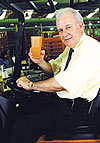
Soda-Club sells products for $100 million a year in Germany: ten million gas cylinders for its Soda Stream instruments, and 15 million bottles. Soda-Club founder and general manager Peter Wiseburgh is also optimistic as regards the future. In a year's time, he can reach 27 million bottles.
"I was told that in Germany, nobody drinks tap water, and that my products therefore didn't stand a chance", he explains. "But I learned that German children, as a matter of fact, love bubbles in the water. Apart from which, Germany has strong bottle deposit laws, with a half Deutsche Mark deposit per bottle. So people prefer to make their own bubbles at home".
In his plant, they manufacture the Soda Stream gas cylinders, the instrument itself, and the bottles and the syrup. They don't depend on secondary manufacturers, even controlling the gas-cylinder replacement distribution system, through agents. The company shortly intends introducing a new product: "a drinking water purifier, that can clear the water of all pollutants, chlorine and bacteria", Wiseburgh enthuses. "This is a non-chemical system, that can be installed on the pipes or in flasks. We have triple patents on it, and if the product does not flop in the market, we will set up a separate subsidiary to manufacture it".
Six ruinous years
58-year-old Wiseburgh was born in England, immigrated to Israel in the seventies, and has since struck deep roots here. He has six children and lives in Jerusalem's German Colony. His company is located in the Mishor Adumim industrial zone. He sponsors Jerusalem's Hapoel basketball team, and has set up a fund for the encouragement of commercial technological R&D for Jerusalem students. It was he who initiated the old motorcar cavalcade from England to Jerusale, a year ago, raising hundreds of thousands of dollars to create water reservoirs in the Negev.
The forthrightness with which he speaks of his difficult years elicits one's sympathy. "The first six years were an unbroken succession of crises", he recollects. "I started out in Israel as a product distributor for Britain's Soda Stream in 1978. Inflation in 1979 was ruinous, especially for importers. On top of all those difficulties, in 1980 I was required to pay purchase taxes on all the gas cylinders. In 1982, we found ourselves without workers, due to the war. In 1983 the banks collapsed. It cost us $300,000. That year the Tel Aviv Stock Exchange collapsed, I woke up one fine morning with 33% less in foreign currency. In 1984, when we were starting to recover, price control was imposed, and in 1985, there was the currency changeover to the New Israel Shekel, foreign currency exchange rates were frozen and banks were given permission to determine interest rates, which promptly reached 20% a month. Then we were really in trouble".
Wiseburgh recites them off by heart, every pitfall on the way, only so as to be able to say, on reaching the end of his tale of woe: "It was a baptism of fire that strengthened me. Now I can say, yes, I am succeeding. I did it. That is my attitude".
It was in 1986 that the worm turned. Two Soda Stream containers blew up in the faces of thirsty customers, and Wiseburgh started to wonder how to get out of this embarrassment. He approached the company in England with a demand for security.
"I was nervous, so I hired engineers and we started to design safer containers", he explains. "At the same time, I sued the British for negligence. It took twenty-one months to get the new product to market. I believe success comes to those who manage to produce in a catastrophic situation. What happened was that by 1989, we had managed to sell 450,000 instruments. By 1999, there were over a million of them in Israel".
But Israel is only a small branch. Wiseburgh's gaze is outward directed. Ninety percent of the company's output is earmarked for export. In 1999, Wiseburgh gained control of Soda Stream, and Soda-Club today controls 80% of the world market of home production of soda. Wiseburgh maintains that every fifth resident in Germany, Switzerland, South Africa and Holland has a Soda Club instrument.
Half a million for a NIS 0.25 deposit
In recent years, Wiseburgh has been nurturing another baby, apart from soda manufacture. He is dedicating a great deal of time, energy and money to the attempt to promote legislation and have a bottle deposit law go into effect. Such a law would require soft beverage manufacturers to collect deposit fees on the beverage bottles and containers they sell, as many other countries do. The consumer gets his deposit back only if he returns the empties, which constitutes an incentive for reducing the quantity of waste making its way to garbage dumps.
Wiseburgh sells a beverage for home manufacture, and thus has an obvious economic interest in promoting such a lay, whose immediate impact would be an increase in the prices of soft beverages and higher costs for manufacturers and chain stores. "I am not being sanctimonious about this, certainly I have an interest", he says, "but it conforms to the public interest. Someone has to worry about garbage. Bottle manufacturers have no such interest, marketing chain stores have no room for it. So ultimately, the bottles reach and pollute the public domain".
The original deposit bill was submitted back in 1992. The intention was that manufacturers should make repeat use of their bottles, thereby cutting garbage quantities by one third. The bill lay buried for years, until, in April 1999, it was resurrected and passed by the Knesset plenum, due to take force this April. The Ministry of Finance opposed it and a clause in the Arrangements Law provides that the law will take effect only in 2001. But as luck would have it, MK Avraham Poraz, one of those who initiated the original bill, was appointed head of the Economic Affairs Committee, and took steps to achieve a compromise that would enable the law to take force earlier. For now, at least, there should be a delay of only a few months after April, but countervailing pressures will presumably continue.
Spearheading the opposition, Wiseburgh claims, is the Manufacturers Association. The offensive mounted by the manufacturers led Wiseburgh to found the "Forum for the Deposit Law" which has as members, apart from the founder, also a number of ecological organisations.
Today it appears that Wiseburgh's struggle has long passed beyond the bounds of mere business interest. "We secured an unexpected degree of involvement. We met with mayors and MKs, the whole team enlisted and got involved. The lobbying on behalf of the law cost us half a million dollars", he admits.
The world is thirsty for our water
Peter Wiseburgh certainly has every reason to be satisfied with his lot. In the Dun & Bradstreet rating for 1998 (published a year ago), Soda Club ranked 115th in a list of the Israel economy's 150 leading companies. A respectable position by any yardstick.
Wiseburgh is happy to demonstrate Soda Stream's growth potential using data on the German market, which not many Israelis have managed to penetrate successfully. "In 1998, when we bought Soda Stream", he relates, "we were astonished to discover that while it had succeeded in selling the instrument in Germany, it hadn't sold even a single bottle of syrup there. We now sell 300,000 bottles of syrup in Germany. We realised what the market needed".
But Wiseburgh has another reason for basing himself on his sales in Germany. The German market accounts for 75% of Soda Club's total sales, the remainder being divided mainly among Switzerland, Holland, Poland and other European countries. But Wiseburgh is eyeing the rest of the world.
Wiseburgh estimates that within a year he can reach sales of $4 million in the United States. After that, he intends to open up markets in the Far East and South America.
"Globes": Where will you get the necessary funds for these investments?
Wiseburgh : "At the moment, there is no need to raise capital by issuing. We have already been accepted into a number of stock exchanges in Europe, but we are in no hurry to realise this right".
Peter Wiseburgh knows that the instrument he manufactures is not a very sexy one and he wants to change that. "We negotiated with Italian company Alessi, to design the instrument for us, but it fell through". Wiseburgh himself has approached designers, including well-known names such as Ron Arad, asking them to redesign the instrument. He knows that in order to go on selling, he must innovate.
NIS 150 million, because of the deposit
Peter Wiseburgh hates to complain, describing himself as an optimist. During the interview, he gave chapter and verse of the difficulties he had encountered over the years. Of the fact that he almost had to face a NIS 150 million class action suit he preferred not to speak, even though, ultimately, he came out ahead. The Supreme Court overturned the decision of Judge Adi Adar of the Tel-Aviv District Court, who, in June 1999, gave leave to bring a class action again Soda Club.
To this day, Wiseburgh believes the reason for the lawsuit was a media report that Soda Club intended to go public. "I know there were some people who wanted to injure us", he says. "But what is important is that they failed".
Published by Israel's Business Arena on 28 February, 2000