Sponsored content by SkillReal
Until recently, America’s Generac was known mainly for home standby generators. Today it is converting factories to build the large generators data centers require, investing some $250 million in the effort and hiring around a thousand people. Its order backlog from the data center market stands at roughly $1.6 billion.
Generac is not alone. Makers of cooling systems, transformers, cables, electrical equipment and even metal wall panels are riding the same wave. It is one of the less-told stories of the data center boom: the big money does not stop at the chipmakers. It flows deep into the supply chain and sometimes reaches companies that nobody associated with the sector two years ago.
A Waiting List That Runs to 2028
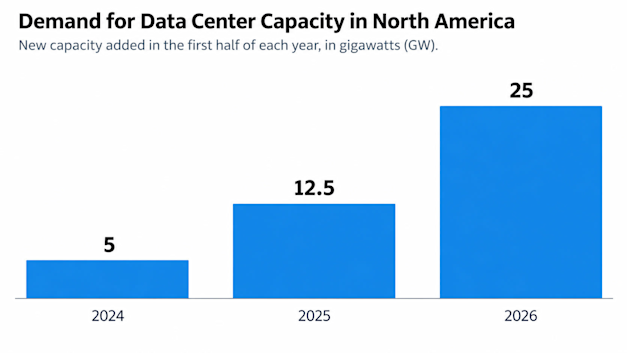
Illustration: Or Yaakobi
Demand is breaking records. North America absorbed 25 gigawatts of data center capacity in the first half of 2026, twice the figure for the same period a year earlier and five times the level of two years ago, according to JLL. Another 66 gigawatts are under construction, and 95% of that capacity has already been booked. Occupancy is tight enough that a customer signing a contract today is reserving space for 2028.
The global picture looks the same. At the end of 2025, roughly 1,360 large hyperscale data centers were operating worldwide, run by Amazon, Microsoft, Google, Meta, and Oracle. Synergy Research expects those operators to hold about two-thirds of total global data center capacity by 2031, with their own capacity more than tripling.
Hundreds more facilities are already in planning.
The Second Race: Who Supplies the Equipment, and When
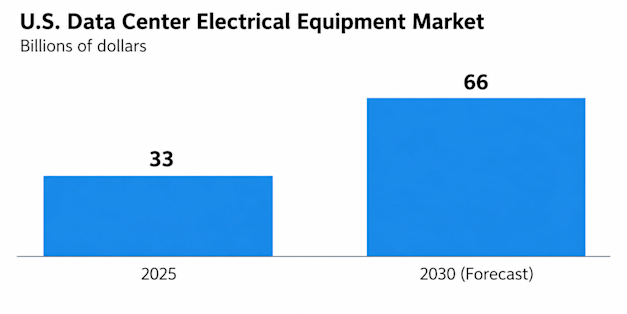
Illustration: Or Yaakobi
The first race was for land and power. The second is no longer about sites. It is about delivering equipment on time. More than half of the data center projects built in 2025 ran behind schedule. Lead times for heavy electrical equipment, including medium-voltage switchgear, transformers and large generators, have stretched between two and four times what they were before 2020. Developers now order eighteen months to two years ahead simply to avoid getting stuck.
Manufacturers are expanding capacity, and when that is not enough, they buy it. In late August, nVent announced the acquisition of Maverick Power for $1.75 billion, partly to expand its data center business.
These are all expressions of the same phenomenon. A market growing these fast forces entire factories to change their priorities and their pace, and that is a bigger challenge than it sounds.
The Third Race: Producing More Isn’t Enough
When a large customer issues a tender, price is only part of the equation, and sometimes not the important part. The plant has to prove it can hold the volumes, deliver on time, and maintain the same level of quality when the line is running much faster.
So, manufacturers add production lines, machines, and people. But another machine does not speed up production if the bottleneck sits somewhere else, and more often than not it sits in quality inspection. A plant can double the number of parts it makes in a day. If inspection still means pulling a part off the line, carrying it to an inspection cell and waiting for a result, inspection sets the pace, not production.
At data center assembly sites, where assembly itself runs at unprecedented speed, a part that is out of tolerance costs expensive working days and can cause embarrassing failures. Large customers now require plants bidding tenders to show fast, automated quality inspection on the production line itself.
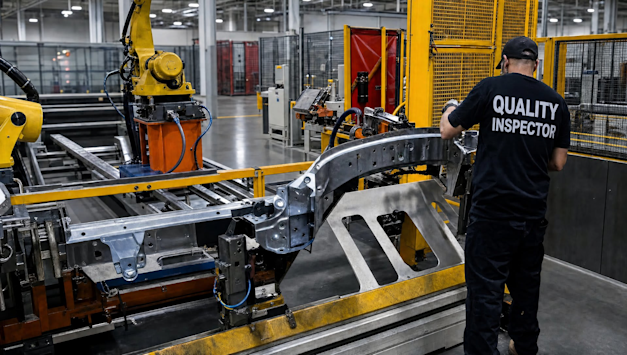
Offline inspection adds a separate measurement step; inline inspection checks and accurately measures the part on the line itself / Photo: Or Yaakobi
Technology Built for Automotive, Found by a New Market
One of the companies now running into that bottleneck came to it from the auto industry. SkillReal, an Israeli company founded in 2020, has developed a software platform for dimensional and quality inspection directly on the production line. Its team includes graduates of Talpiot, the Israeli military’s elite science and technology program, and engineers with advanced degrees from the Technion.
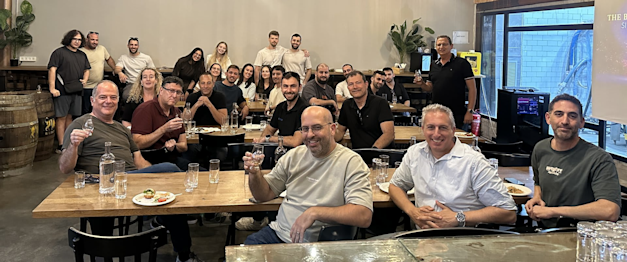
SkillReal's team is celebrating the new order: more than 20 systems at one site, closed in a few weeks / Photo: Or Yaakobi
Instead of pulling a part off the line into a dedicated measurement cell and waiting for a result, or relying on error-prone manual end-of-line checks, SkillReal mounts standard industrial cameras on the existing production line and checks every part produced, inline place. The software then runs AI models and billions of 3D calculations per second, made possible in part by the latest generation of Nvidia chips. It uses the part’s CAD model together with the list of features to be checked, including holes, bolts, welds and critical dimensions, and compares what was designed with what was actually built. That comparison happens in real time, without slowing production, with measurement precision that can reach 0.05 mm.
According to the company, deployment does not require building a dedicated inspection cell or ordering a new, complex measuring machine. Engineers define in software what needs to be checked and mount standard cameras directly on the existing production line. When suppliers are asked to add capacity within weeks, that shorter deployment time is decisive. A traditional inspection cell cannot be built and commissioned in that window.
SkillReal’s proving ground was a demanding one: the auto industry, working alongside the world’s largest carmakers and Tier 1 suppliers. Complex products made in the millions, fast lines, tight tolerances, and a conservative industry.
Over the past year, the company has booked millions of dollars in orders, and its commercial activity is growing quickly. Its systems run on production lines in the US, Europe and Japan, together performing more than 80 million measurements of geometric features a month. Its investors include several automotive industry veterans, among them Rick Wagoner, former chairman and CEO of General Motors.
How the New Market Found SkillReal
A few weeks ago, the company was approached by an American manufacturer of metal structures for data centers and logistics centers. The connection did not come out of a sales campaign. One of the large end customers, a hyperscaler, had come across SkillReal’s technology in manufacturing, and when its supplier was asked to scale output quickly, SkillReal came into the picture.
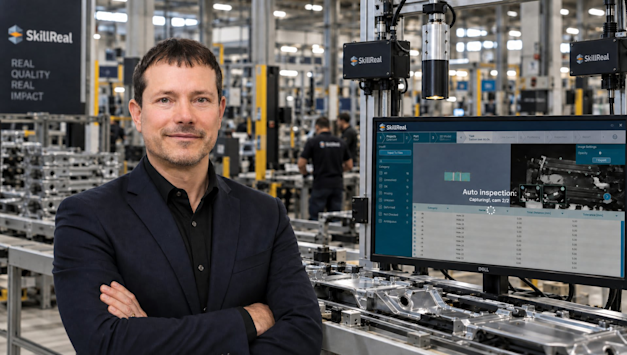
"This isn’t a pivot away from automotive; it’s an extension of the same core technology platform. What we’re seeing right now is a new market opening up: new production lines, new plants, manufacturers fighting to win data center tenders, and our systems are the only ones we know of that give them the speed and complete inspection capability they need," says Shai Newman, CEO, SkillReal.
Technologically, the change was small: different parts, different CAD file, same principle. Commercially, it was dramatic. More than 20 systems were deployed at a single site in an order worth roughly $3.5 million.
Market pressure compressed the whole process. Scoping and negotiation were completed, and the initial order was placed within a few weeks.
"The auto industry was an excellent starting point for us," says Shai Newman, CEO of SkillReal. "If a technology can measure complex parts in real time on fast automotive lines, it solves the same problem in other industries too. In the logistics and data center supply chain, the pressure to scale output very quickly creates a new need: automated inline inspection that can be installed and brought online in weeks, not months." The company is already mapping additional suppliers across the data center supply chain.
Which Horse to Back
The direction is clear. Hundreds more large data centers are in planning, hyperscale capacity is expected to triple by 2031, and the whole supply chain has to produce faster and at greater scale. Investors will pick their horse, and the ones delivering excess returns will not necessarily come from the obvious industries, where the market has already priced the opportunity in. Some of those opportunities sit a layer deeper: in the technologies that let manufacturers scale up without quality control or manual processes becoming the next bottleneck.
SkillReal illustrates a different kind of winner from the boom: companies built for one market that hold technology which suddenly becomes relevant when a supply chain is asked to produce faster and at greater scale. For investors, the interesting question is how many more such horses are hiding today in industries nobody yet classifies as data center industries.
For more information about SkillReal company>>
Sponsored content by SkillReal